
Pyrolysis is a thermal process that breaks down organic material in a low-oxygen environment. Instead of burning biomass, it transforms it into biochar and valuable co-products — the foundation of everything we plan to build.
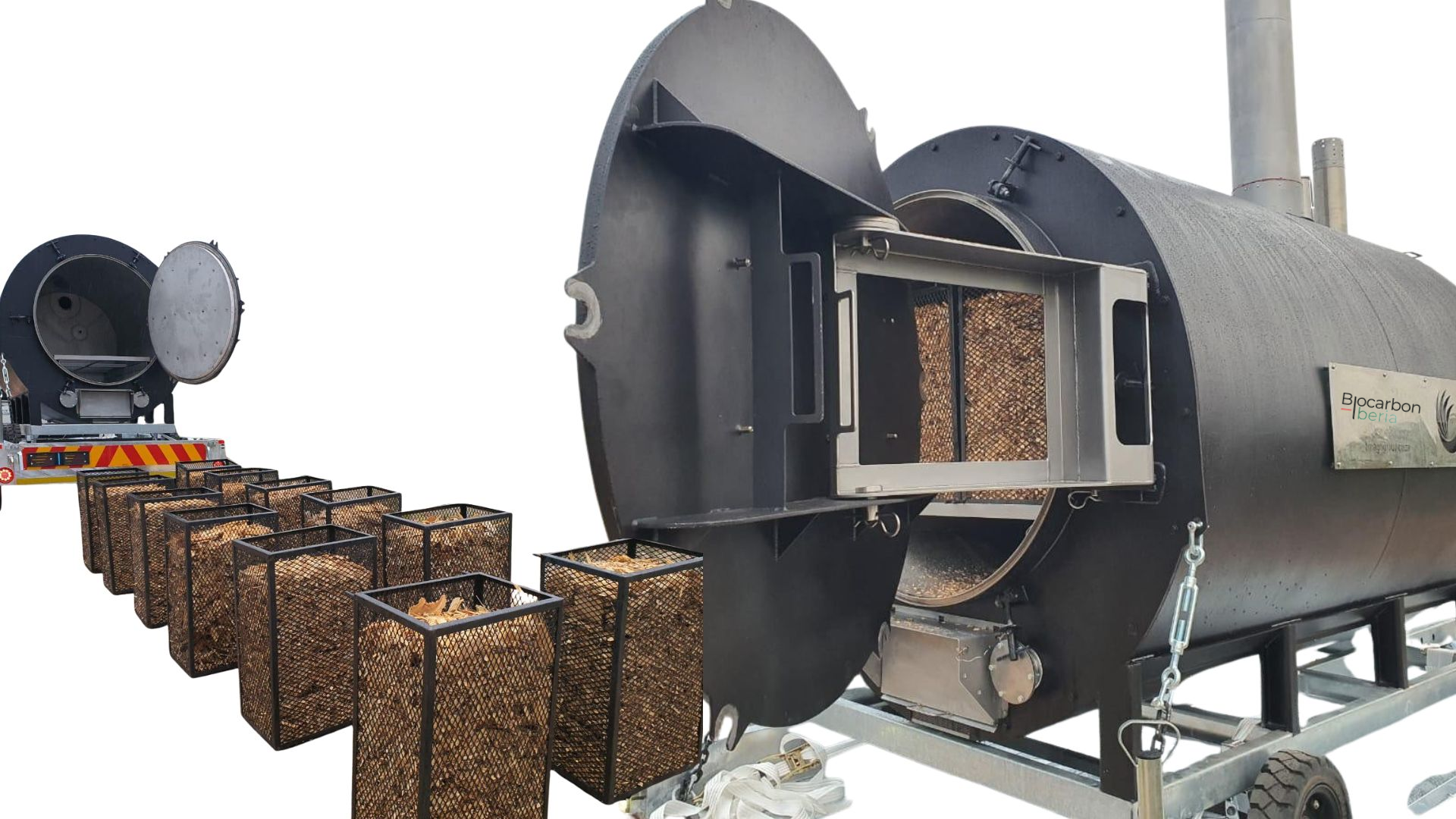
By applying heat in the near-absence of oxygen, pyrolysis decomposes biomass into a solid carbon fraction and volatile compounds. The result is a way to stabilise carbon that would otherwise decompose or burn and return to the atmosphere.
A single controlled process yields one solid and three fluid streams. The exact balance depends on feedstock and operating parameters.
Biomass & Waste
Forestry, agriculture & suitable residues
Pyrolysis
Controlled, low-oxygen thermal conversion
Biochar
Stable carbon
Bio-oil / Wood Vinegar
Agricultural & industrial
Syngas / Heat
Energy recovery
A stable, carbon-rich solid intended for soil improvement, filtration and industrial applications.
A liquid co-product with potential agricultural and industrial uses under evaluation.
A liquid energy carrier that could support renewable energy and material applications.
A combustible gas that may be recovered to help power the process itself.
Pyrolysis is not a single fixed recipe. A few key variables shape whether the process favours biochar, liquids or gas.
Conversion typically occurs in a controlled range where biomass thermally decomposes without combustion.
Restricting oxygen prevents burning, so carbon is retained in the char rather than released as CO2.
How long biomass stays in the reactor influences the balance between solid, liquid and gas outputs.
We plan a phased approach that de-risks development: proving the model with mobile units before scaling toward continuous industrial capacity.
Compact, transportable units that can be brought to where biomass is generated. This reduces transport of low-density residues and lets us demonstrate the process close to forestry and agricultural partners.
Larger, permanent installations designed for continuous throughput and integrated energy recovery — the pathway toward durable carbon removal and co-product supply at regional scale.
Figures are indicative of the technology and our development plans, not guaranteed performance of a specific facility.
We are happy to share more on our planned technology approach, feedstock strategy and phased deployment with serious partners and investors.